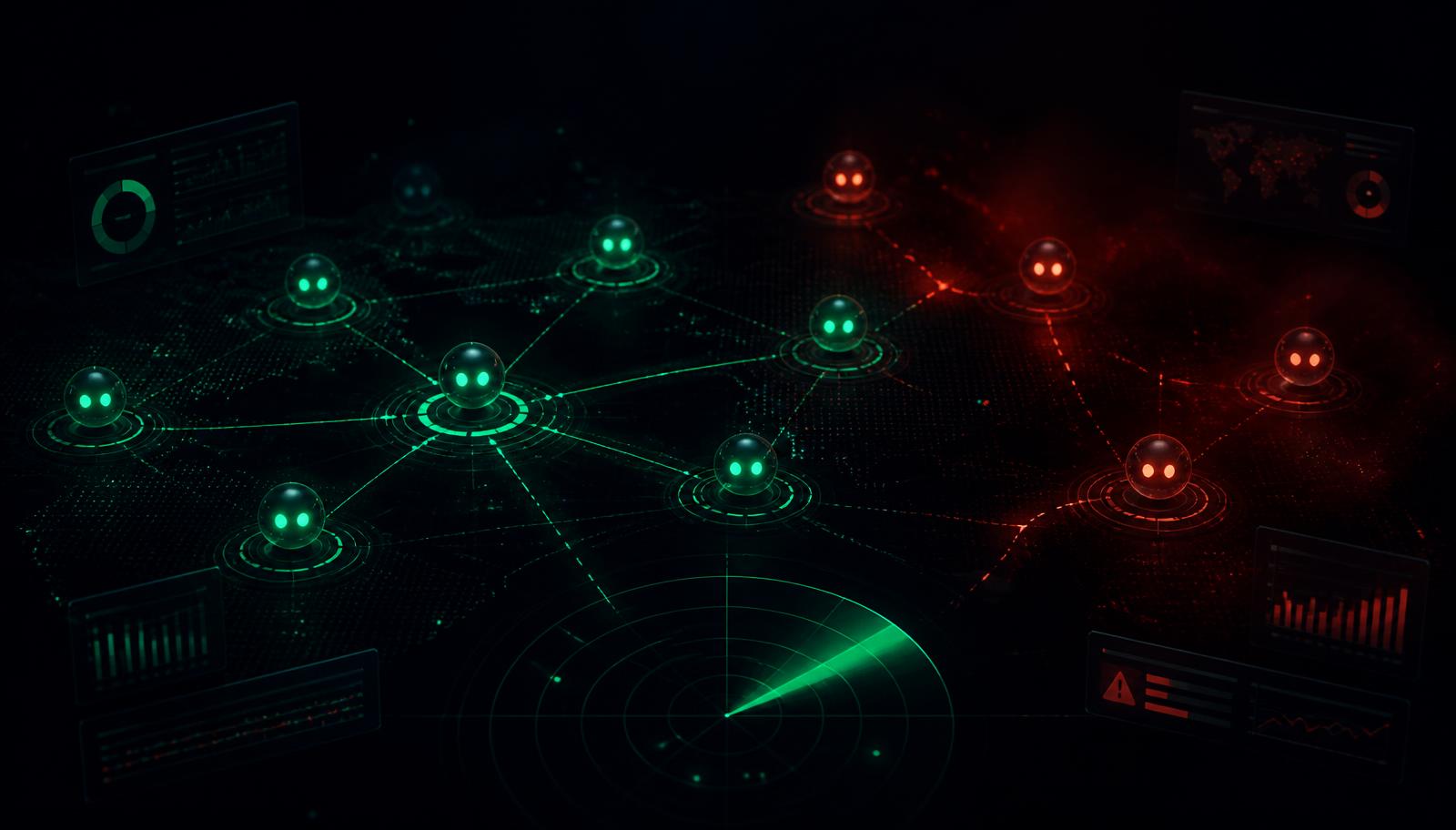
Shadow AI Agents: How to Discover and Govern Unsanctioned AI in Your Organization
Shadow AI agents — unsanctioned chatbots, copilots, browser extensions, and autonomous workflows employees deploy without IT approval — are the fastest-growing blind spot in enterprise security. Here is how to discover shadow AI, the risks it creates, and a step-by-step governance framework to bring it under control.

Shadow AI has quietly become one of the largest unmanaged risks in the modern enterprise. While security teams focus on the AI agents they have officially deployed, employees across every department are signing up for ChatGPT accounts, installing AI browser extensions, connecting third-party copilots to SaaS platforms, and building autonomous workflows in tools like Zapier, Make, n8n, and low-code agent builders — often with no visibility, approval, or oversight from IT or security.
This guide explains what shadow AI agents are, why they are spreading so quickly, the specific risks they create, and a practical framework you can use to discover, inventory, and govern unsanctioned AI before it becomes a breach, compliance violation, or operational incident.
What are shadow AI agents?
Shadow AI agents are any AI-powered tools, assistants, copilots, autonomous workflows, browser extensions, plugins, or integrations used within an organization without the knowledge or approval of IT, security, or governance teams. The term builds on the older concept of shadow IT, but the risks are far greater. A shadow SaaS app typically stores data. A shadow AI agent reads sensitive data, reasons over it, generates new content, makes decisions, and increasingly executes actions across connected systems. Common examples include personal ChatGPT, Claude, Gemini, or Copilot accounts used for work, AI note-takers that join meetings and transcribe conversations, AI browser extensions that read every page an employee visits, AI coding assistants pulling from private repositories, marketing teams running content workflows through unsanctioned automation platforms, and analysts building autonomous research agents on top of open-source frameworks.
Why shadow AI is spreading faster than IT can keep up
Three forces are driving the explosion of shadow AI inside organizations. First, AI tools are extraordinarily easy to adopt — a free account and a browser are all most employees need to start moving sensitive data into a third-party model. Second, the productivity gains are real and visible; employees who use AI to draft emails, summarize documents, write code, or analyze data feel measurably faster, which creates strong personal incentive to keep using whatever works. Third, formal approval processes inside most enterprises are too slow — when a security review takes six weeks and a free tool takes six seconds, employees route around the process. The result is a widening gap between the AI an organization has officially sanctioned and the AI it is actually running on.
The real risks of unsanctioned AI agents
Shadow AI is not just a policy problem. It creates concrete, measurable risk across four categories. Data leakage occurs when employees paste customer records, source code, financial data, contracts, PHI, or internal strategy documents into consumer-grade AI tools whose terms of service may allow training on submitted data, whose retention policies are unclear, and whose security controls have never been reviewed. Compliance violations occur when shadow AI processes regulated data outside the controls required by GDPR, HIPAA, PCI DSS, SOC 2, or industry frameworks — and because the activity is invisible, organizations cannot honor data-subject requests, demonstrate processing records, or respond accurately to audits. Untracked decision-making occurs when shadow agents draft customer communications, generate financial analyses, write code that ships to production, or take autonomous actions with no audit trail, making it impossible to investigate errors or attribute responsibility. Expanded attack surface occurs because every shadow tool is an unreviewed integration — a new vector for prompt injection, credential theft, malicious extensions, and supply-chain compromise.
How big is the problem? What the data shows
Independent surveys from 2024 and 2025 consistently find that between 55% and 78% of knowledge workers use generative AI tools at work, while only a small fraction of their employers have formally approved those tools. Studies of enterprise network traffic routinely identify dozens of distinct AI services per organization, most of which never appear in the corporate SaaS inventory. The consistent pattern: whatever number your CIO believes, the real number of shadow AI tools in your environment is five to ten times larger. Assume undercount, not overcount.
Step 1: Build a multi-source discovery process
No single signal captures every shadow AI agent — effective discovery combines several data sources. Pull DNS and egress logs from your firewall, SASE, or secure web gateway and look for traffic to known AI domains, model APIs, and AI-tool vendors. Audit your SSO and OAuth grants for any application that requests access to email, files, calendars, or repositories on behalf of users. Inventory browser extensions across managed devices — AI sidebars and writing assistants are among the most common shadow agents and have broad page-read permissions. Reconcile expense reports and SaaS-management platform data against your approved catalog. Pull endpoint telemetry for newly installed AI desktop apps and meeting bots. Finally, run an anonymous employee survey — people will tell you what tools they actually use if you make it clear the goal is enablement, not punishment.
Step 2: Inventory and classify what you find
Once you have raw discovery data, consolidate it into a single shadow AI inventory. For each tool, capture the vendor, the team using it, the type of data it touches, whether it has agentic capabilities (autonomous actions, tool calls, multi-step workflows), the integrations it has been granted, and a preliminary risk rating. Classify each entry as approve, restrict, replace with a sanctioned equivalent, or block. Most shadow AI falls into the middle two categories — the tools are useful, but the way they are being used needs to change.
Step 3: Stand up an approved AI catalog and a fast-track review
The single most effective control against shadow AI is a credible, fast alternative. Publish an approved AI catalog with clear guidance on which tools are sanctioned for which kinds of data. Pair it with a lightweight intake process that can review and decision new tools in days, not months. When employees know there is a legitimate path to the AI they want, the incentive to route around IT collapses.
Step 4: Enforce least-privilege defaults on every AI integration
Every approved AI agent — and every replacement for a shadow one — should be deployed under least-privilege defaults. Scope OAuth tokens narrowly, restrict tool calls to the minimum systems required, isolate data sources, and disable training on submitted content where the vendor allows. Assume any AI integration could be compromised tomorrow and design the blast radius accordingly.
Step 5: Monitor prompts, tool calls, and agent actions continuously
Discovery is a point-in-time exercise; governance is a continuous one. Once your sanctioned AI agents are in place, monitor every prompt, retrieval, tool invocation, and autonomous action in real time. Look for anomalous data access, prompt-injection patterns, sudden spikes in token usage, unexpected external calls, and policy violations. Continuous monitoring is also what gives you the audit trail regulators and customers increasingly expect.
Step 6: Write an acceptable-use policy people will actually follow
An AI acceptable-use policy should be short, specific, and pragmatic. Spell out which data categories are off-limits for any external AI tool, which sanctioned tools are approved for which use cases, how to request a review for a new tool, and what monitoring employees should expect. Avoid blanket bans — they push shadow AI further underground without reducing actual usage. The goal is to make the safe path the easy path.
Common shadow AI mistakes to avoid
Three patterns reliably make shadow AI worse, not better. Banning AI outright drives the most productive employees to personal devices and personal accounts, where you have zero visibility. Relying only on network blocking misses every AI tool accessed through a browser-based SaaS frontend or a personal device on a hotspot. Treating discovery as a one-time project ignores the reality that new AI tools launch every week — your inventory is stale within 30 days unless discovery runs continuously.
Where Watch Tower Agents fits
Watch Tower Agents helps security and governance teams bring shadow AI under control by discovering AI agents and integrations across the environment, inventorying their permissions and data access, classifying risk, and continuously monitoring prompts, tool calls, and autonomous actions in real time. Teams get a single source of truth for every AI agent — sanctioned or not — along with the audit logs, anomaly detection, kill-switch controls, and compliance evidence needed to meet SOC 2, HIPAA, PCI DSS, and GDPR requirements without slowing the business down.
The bottom line
Shadow AI is not a future problem. It is already running in your environment, touching regulated data, making decisions, and expanding your attack surface. The organizations that get ahead of it will not be the ones that ban AI hardest — they will be the ones that discover it earliest, govern it continuously, and give their teams a fast, safe, sanctioned path to the productivity gains AI actually delivers.
Frequently asked questions
What is a shadow AI agent?
A shadow AI agent is any AI tool, copilot, browser extension, plugin, or autonomous workflow used inside an organization without IT, security, or governance approval. Examples include personal ChatGPT or Claude accounts used for work, AI meeting note-takers, AI browser sidebars, unsanctioned coding assistants, and automation workflows built on Zapier, Make, or n8n that call external models.
Why is shadow AI dangerous?
Shadow AI creates four concrete risks: data leakage into third-party models with unclear retention or training policies, compliance violations under GDPR, HIPAA, PCI DSS, and SOC 2, untracked decision-making with no audit trail, and an expanded attack surface for prompt injection, credential theft, and malicious extensions.
How do I discover shadow AI in my organization?
Combine multiple signals: DNS and egress logs from your firewall or secure web gateway, SSO and OAuth grant audits, browser-extension inventories on managed endpoints, expense and SaaS-management data, endpoint telemetry for new AI apps and meeting bots, and an anonymous employee survey. No single source catches every shadow agent.
Should we just ban AI tools to stop shadow AI?
No. Blanket bans push shadow AI onto personal devices and personal accounts where you have zero visibility. The effective approach is an approved AI catalog, a fast-track review process for new tools, least-privilege defaults, and continuous monitoring — making the safe path the easy path.
How does Watch Tower Agents help with shadow AI?
Watch Tower Agents discovers AI agents and integrations across your environment, inventories their permissions and data access, classifies risk, and continuously monitors prompts, tool calls, and autonomous actions — giving security teams a single source of truth and the audit evidence needed for SOC 2, HIPAA, PCI DSS, and GDPR compliance.
Govern your agents before they ship
See WatchTower running on your stack in a 30-minute walkthrough.
Keep reading