AI Agent Identity: How to Manage and Secure Non-Human Identities in 2026
AI agent identity is the credential, scope, and behavioral fingerprint that lets an autonomous agent act on behalf of your business — and lets you prove who did what. This guide explains what AI agent identity is, why it is different from human IAM, how to issue and rotate agent credentials, how merchants verify agent identity at checkout, and the controls enterprises need to govern non-human identities in 2026.

Inside most enterprises, the fastest-growing population of identities is not human. It is AI agents — copilots booking meetings, sales agents drafting and sending emails, finance agents reconciling invoices, support agents issuing refunds, and engineering agents opening pull requests at three in the morning. Each of those agents needs to authenticate to something: a CRM, a database, a payment processor, an internal API, another agent. The credentials they use, the scope of what they can do, and the audit trail they leave behind are collectively called AI agent identity — and in 2026 it is the most under-governed surface in the enterprise stack.
This guide explains what AI agent identity is, how it differs from human IAM and from traditional service accounts, the specific risks of getting it wrong, the standards and patterns emerging in 2026 (including how merchants verify agent identity at checkout), and a practical control set to bring non-human identities under governance.
What is AI agent identity?
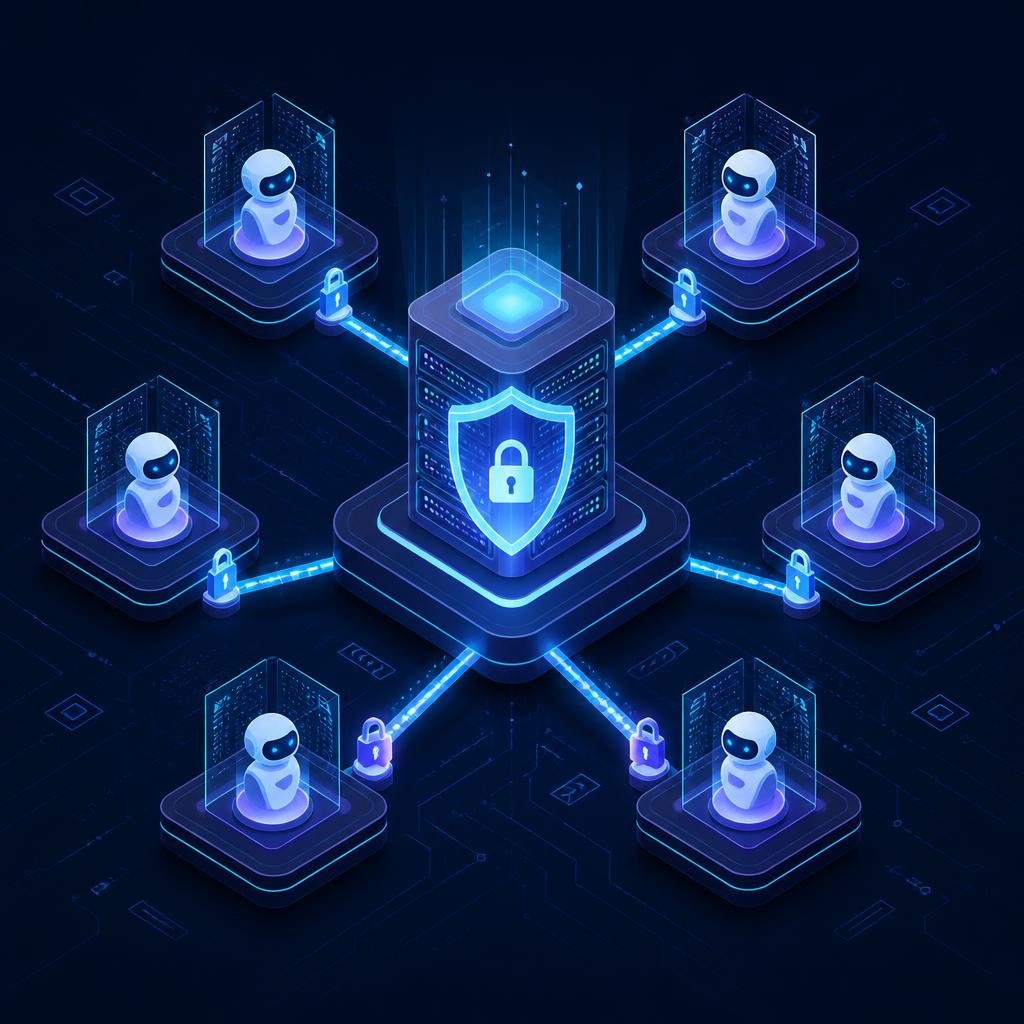
AI agent identity is the cryptographically verifiable answer to three questions for every action an autonomous AI agent takes: which agent took the action, on whose behalf did it act, and with what authority. In practice, an agent identity is a bundle: a stable agent ID, a short-lived credential (token, signed assertion, or mTLS cert), a scoped set of permissions, an on-behalf-of (OBO) claim that links the action to a human principal or business entity, and a behavioral fingerprint used to detect impersonation or drift. Without all five, you have a service account with a fancy name — not an identity you can govern.
AI agent identity vs human IAM vs service accounts
Human IAM assumes a person at a keyboard, an MFA prompt, an SSO session, and behavioral patterns learned over years. Service accounts assume a single workload with a known network path and a long-lived secret. AI agents break both models. An AI agent may be invoked by any user, can act across many systems in a single task, makes non-deterministic decisions, spawns sub-agents, and operates at machine speed. Its credentials need to be short-lived, scoped per task, bound to a session, and traceable back to the human or business principal that authorized the work. Treating an agent like a service account — one static key, broad scopes, no session binding — is how you end up with a runaway agent that holds the same token for 18 months and quietly exfiltrates data on schedule.
Why AI agent identity matters in 2026
Three things have changed. First, non-human identities (NHIs) now outnumber human identities by roughly 50 to 1 in the average enterprise, and AI agents are the fastest-growing NHI category. Second, agents have moved from read-only assistants to write-capable actors — they spend money, change records, deploy code, and contact customers. Third, the ecosystem is starting to demand proof of identity at every hop: payment networks want to know whether a checkout was initiated by a human, a delegated agent, or an unverified bot; API providers want signed user-delegation tokens before they accept agent traffic; auditors want per-action attribution. If your agents cannot prove who they are, they will increasingly be blocked, rate-limited, or rejected at the edge.
The real-world failure modes
The failures are predictable. Static API keys checked into a repo and reused by an agent for a year. Shared service accounts where ten different agents authenticate as the same identity, making per-agent attribution impossible. Over-scoped OAuth tokens granting agents full admin when they need a single endpoint. No session binding, so a leaked token works from anywhere. No revocation path, so when an agent is compromised the only option is to rotate a secret used by dozens of workloads. No on-behalf-of claim, so when an agent moves $40,000 you cannot tell whether the CFO approved it or a prompt injection did. And no behavioral baseline, so a compromised agent looks identical to a healthy one until the damage is visible.
How merchants verify AI agent identity at checkout
Agentic commerce is forcing the first widely deployed AI agent identity standards. When an AI shopping agent attempts a checkout on behalf of a consumer, merchants and payment networks now look for several signals: an agent attestation header identifying the agent platform and version, a signed user-delegation token proving the human authorized this specific purchase scope (merchant, category, max amount, expiry), a passkey or device-bound credential anchoring the human principal, and a risk score derived from the agent's behavioral history. Visa's Trusted Agent Protocol, Mastercard's Agent Pay, and the emerging Web Bot Auth / HTTP Message Signatures work at the IETF all converge on the same idea: agents present cryptographic identity at the edge, merchants verify it, and unverified agent traffic is treated as higher risk or blocked outright. Expect the same pattern to spread from checkout to any high-value API in 2026.
The 2026 agent identity standards stack
Several standards are converging into a usable stack. OAuth 2.0 with the token-exchange grant (RFC 8693) lets you mint short-lived, scoped agent tokens that carry an on-behalf-of claim for the human principal. JWT-Secured Authorization Request (JAR) and DPoP bind tokens to a specific key so a stolen token cannot be replayed from another host. HTTP Message Signatures (RFC 9421) let agents sign each outbound request, giving API providers per-call verification. SPIFFE/SPIRE issues workload identities for agent runtimes inside a cluster. Model Context Protocol (MCP) is standardizing how agents discover and authenticate to tools. None of these are silver bullets, but together they replace the static-key pattern with a verifiable, revocable, per-session identity.
The core control set for AI agent identity
Bring the same rigor to agent identity that you bring to human IAM, with adjustments for machine speed and scale. Maintain a single inventory of every agent identity — sanctioned and discovered — with owner, purpose, data scope, and tool permissions. Issue credentials per session, not per agent: short TTLs (minutes to hours), scoped to the minimum tool set, bound to the calling context. Enforce least privilege at the tool-call layer, not just the API layer — an agent with database access should still be limited to specific tables and operations. Require an on-behalf-of claim on every action that touches user data or external systems, and store it in the audit log. Rotate and revoke automatically; if a credential cannot be killed in under a minute, treat it as a static secret. Baseline behavior per agent identity — typical tools, typical destinations, typical volumes — and alert on deviations. And ensure every action is traceable from outcome back to agent identity, on-behalf-of principal, prompt, and tool call.
Common pitfalls to avoid
Do not let agents share service accounts — you lose attribution the moment two agents authenticate as the same identity. Do not issue long-lived personal access tokens to agents; PATs were designed for humans and inherit human-level scopes. Do not store agent credentials in prompt context where a prompt injection can exfiltrate them. Do not treat the LLM provider's API key as your agent's identity; that key authenticates you to the model, not the agent to your systems. And do not assume that because an agent is internal it does not need an identity — internal agents cause the largest blast radius when something goes wrong.
A 90-day plan to govern AI agent identity
In the first 30 days, inventory every agent currently authenticating to anything in your environment — including shadow agents — and assign each one an owner. In days 31 to 60, replace static keys with short-lived, scoped tokens for the top-risk agents (anything that writes, spends, or touches regulated data), and stand up an on-behalf-of pattern for user-initiated agent actions. In days 61 to 90, turn on behavioral baselining and per-action audit logging, integrate agent identity into your SIEM and incident-response runbooks, and run a tabletop exercise where you revoke a compromised agent identity end-to-end in under five minutes. By the end of the quarter you should be able to answer, for any agent action in the last 90 days, exactly which agent did it, on whose behalf, with what credential, and what guardrails ran.
How Watch Tower Agents helps
Watch Tower Agents gives security and platform teams a unified view of every AI agent identity in their environment — sanctioned and shadow — with credential inventory, scope and permission mapping, behavioral baselining, on-behalf-of tracking, and immutable per-action audit logs that tie every tool call back to an agent identity and a human principal. Instead of stitching identity, observability, and compliance evidence together by hand, teams get one control plane for non-human identities built specifically for agentic AI.
Frequently asked questions
What is AI agent identity?
AI agent identity is the cryptographically verifiable bundle — agent ID, short-lived credential, scoped permissions, on-behalf-of claim, and behavioral fingerprint — that lets an autonomous AI agent act on behalf of a user or business and lets you prove which agent took which action, on whose behalf, and with what authority.
How is AI agent identity different from a service account?
Service accounts assume a single workload with a static, long-lived secret and broad scopes. AI agents are invoked by many users, act across many systems, make non-deterministic decisions, and operate at machine speed. Agent identities must be per-session, short-lived, scoped per task, bound to a calling context, and carry an on-behalf-of claim back to the human or business principal.
How can merchants verify AI agent identity during checkout?
Merchants verify AI agent identity using a combination of signals: an agent attestation header identifying the agent and version, a signed user-delegation token proving the consumer authorized the purchase scope, a passkey or device-bound credential anchoring the human principal, and a risk score from the agent's behavioral history. Emerging standards like Visa's Trusted Agent Protocol, Mastercard's Agent Pay, and IETF HTTP Message Signatures formalize this pattern.
What is a non-human identity (NHI)?
A non-human identity is any identity used by software rather than a person — service accounts, API keys, OAuth apps, workload identities, and AI agents. NHIs already outnumber human identities by roughly 50 to 1 in most enterprises, and AI agents are the fastest-growing NHI category.
How do you secure identities for AI agents and services?
Issue short-lived scoped credentials per session, enforce least privilege at the tool-call layer, require an on-behalf-of claim for actions on user data, rotate and revoke automatically, baseline behavior per identity, and maintain an immutable audit log that ties every action back to a specific agent identity and human principal.
What is AI agent identity management?
AI agent identity management is the discipline of inventorying, issuing, scoping, rotating, revoking, monitoring, and auditing the credentials and behaviors of autonomous AI agents — the equivalent of IAM and PAM, but designed for non-human identities that act at machine speed across many systems on behalf of many principals.
Govern your agents before they ship
See WatchTower running on your stack in a 30-minute walkthrough.
Keep reading